
Background characters are usually just that: background characters. Yet, on occasion, they serve an important role in world-building, even more so when it comes to the theme and storyline.
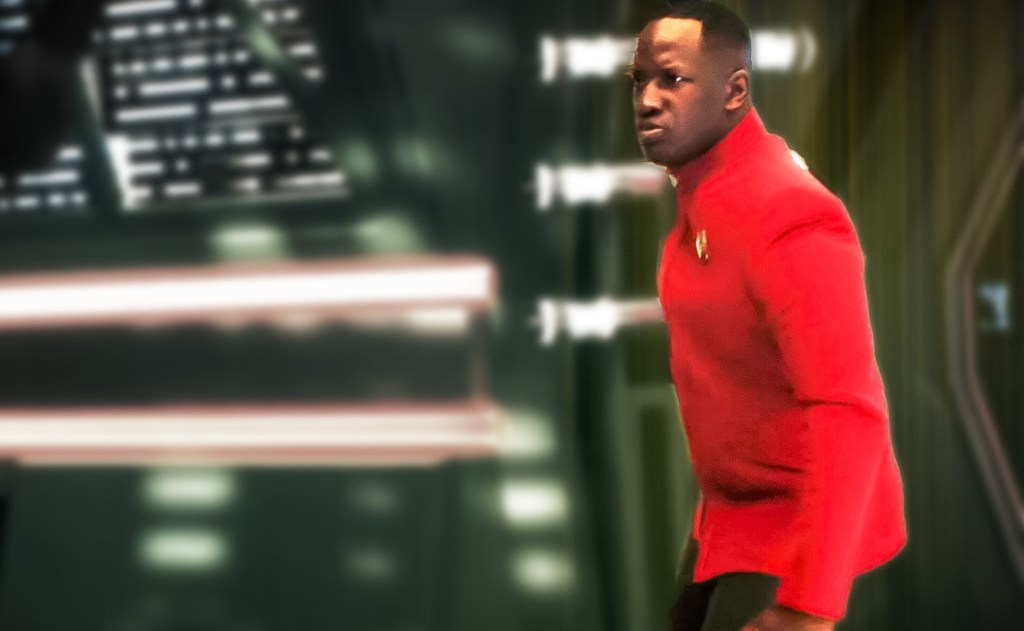
Take, for example, Gene, aka Hazmat Guy, in Star Trek: Discovery, season 3, episode 2. After the crew arrives in the future, there’s a scene where Reno and Paul are having a heated discussion.
The setting is a bit chaotic, as someone in the background is busy cleaning up the remains of Leland. Paul is resistant to working with Reno. However, Reno tells him that they’re going to be working together unless the person cleaning up—whom she refers to as “hazmat”—is going to step in. Hazmat cut in, telling her that his name was Gene. Reno waves off the comment, nonchalantly saying she’s already forgotten his name.
This quick scene might be funny, but it’s loaded with information we never stop to consider. Like, for example, the janitorial crew. We’ve always seen enlisted and commission officers, but never the guys who clean the toilets or clean up the debris. With Gene, aka Hazmat Guy, we know they exist.

Commander Fickett of the USS Credence is another character that gives us context. Discovery Season 4 Episode 3: In just 2 minutes of screen time, Fickett established himself as a fierce fighter going up against the Qowat Milat nuns.
From Kirk to Burnham, we’ve seen a lot of established commanders exhibit their fighting skills, but why is this 2 minutes of an inconsequential character so meaningful?
Well, it reinforces the idea that commanders aren’t just bureaucrats but also trained fighters.
Minor characters like Hazmat Guy and Commander Fickett may seem inconsequential at first glance, but their brief appearances add to the world-building. They remind us that every starship has a diverse crew, with each member playing a vital role on the ship. By acknowledging these background characters, we appreciate the meticulous world-building that makes Star Trek so immersive.
Whether they are cleaning up the mess or fighting against formidable foes, these characters contribute to the sense of a lived-in space where every individual matters. In the end, it’s the attention to these seemingly minor details that lifts Star Trek from a mere sci-fi show to a cultural phenomenon.






 Screen Rated