
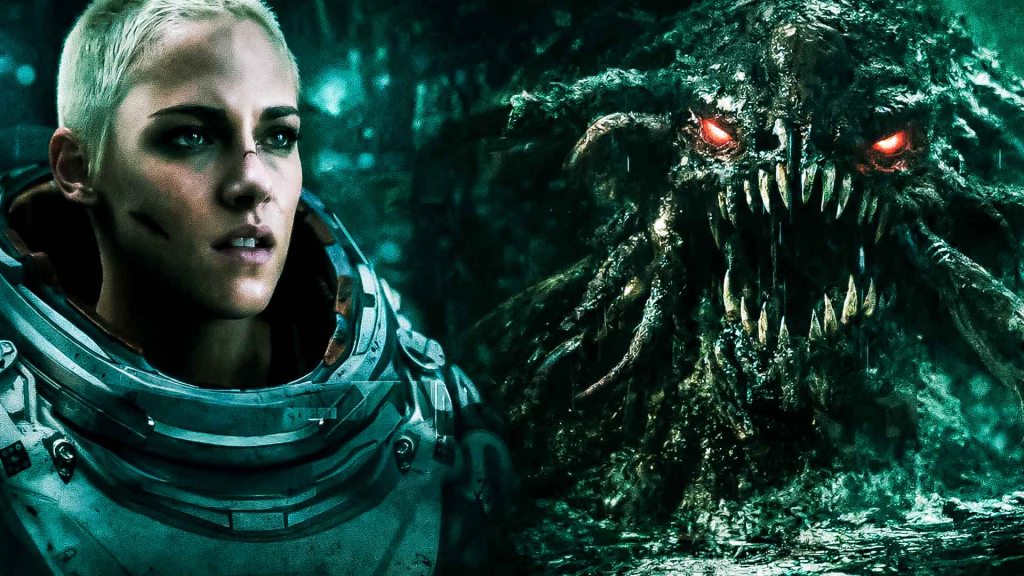
Genre: Sci-Fi | Horror.
When Underwater came out in 2020, it seemed like just another creature-feature set deep in the ocean, where humans encounter a terrifying, unknown force. But what if I told you that it wasn’t just a standalone film but a sneaky sequel to the 1989 cult classic Leviathan?
With some careful viewing, a lot of the evidence starts to point in that direction, and once you connect the dots, it makes for a pretty good case.
Watch the Video Breakdown instead. Is Underwater Secretly a Sequel to Leviathan?
If you prefer seeing the clues instead of just reading about them, I put together a full video breakdown exploring the connection.
Quick synopsis of “Leviathan” (1989)
The crew of an underwater mining station comes across a sunken Soviet vessel and retrieves a bottle of vodka, unwittingly bringing back a genetic experiment. As crew members transform into grotesque, fused creatures, survival becomes a desperate battle against an evolving threat.
Quick synopsis of “Underwater” (2020)
A crew in a deep-sea drilling station faces a catastrophic quake that damages their station. The survivors must find their way through the destroyed modules to reach safety. However, their journey becomes a nightmare as they are stalked by monstrous creatures, culminating in an encounter with a leviathan.
Let’s break down the clues and how “Underwater” ties directly to “Leviathan.”
Monster connection
One of the clearest pieces of evidence comes from the monsters themselves. In Leviathan, two crew members, Six Pack (Daniel Stern) and Bowman (Lisa Eilbacher), become infected with a mutating virus from drinking the vodka. Their bodies fuse into a grotesque, single mass, which is eventually tossed out into the ocean. When they disposed of the fussed bodies, a part of it got cut off while locking the door. It eventually mutated and started hunting the crew.
Jump six decades to Underwater. The giant creature bears some resemblance to the mutated form that was hunting the crew in Leviathan. It’s quite possible that the fussed body that got disposed of continued to mutate in the ocean’s depths, growing into the leviathan we see in Underwater. It could very well be the final form that started with the fused bodies from “Leviathan.”
The doctor’s description
In “Leviathan,” the doctor (Richard Crenna) notes that the mutated creature possesses characteristics of deep-sea life. It has scales, gills, and the ability to spawn hundreds of offspring. The virus works like some kind of bizarre deep-sea evolutionary accelerator. As the doctor explains, the creature is “designed” for life in the ocean.
The idea of an evolving mutation over decades isn’t so far-fetched, and “Underwater” plays right into that idea with its monstrous creature, which, just like the fused body in “Leviathan,” seems to carry the blend of deep-sea fish and human traits. The leviathan in “Underwater” also spawned hundreds of offspring, just like the doctor in Leviathan suggested.
The similarities in technology
The timeline is another big hint. During the start of “Underwater,” a news headline dated February 2, 2050, is shown, meaning 60 years have passed since the Leviathan incident. If we think about how technology evolves, it makes sense that many of the tools and devices used in Leviathan would have been upgraded for use in Underwater. This is especially true when it comes to the diving suits worn by the crew in both films.
While the suits in Leviathan were bulky and clearly 80s tech, the suits in Underwater look like their sleek, high-tech descendants. They’ve retained many of the same basic features, but they’re more advanced, which makes sense after 60 years of technological evolution. It’s as if the suits in “Underwater” are a direct continuation of what we saw in “Leviathan,” as if the same company that made the original suits just kept refining them over the decades.
The abrupt start of Underwater makes sense
Another clue is how abruptly “Underwater” begins. Right from the opening moments, we’re thrown into chaos as the undersea rig starts to collapse. This fast pace makes sense when you think about it as a sequel. All the groundwork was already laid in “Leviathan.” We don’t need an origin story for the creature. We already know about the mutation, the underwater setting, and the deadly risks of deep-sea exploration. All we need is to pick up the action where it left off 60 years later.
“Underwater” as a sequel to ‘Leviathan” isn’t that far-fetched. With the technology looking like a futuristic upgrade and the monster being a mutated version of the fused body from “Leviathan,” it all starts to fit together. Sure, “Underwater” never directly references the events of Leviathan, but that’s what makes it fun. It’s the kind of connection you can make by digging into the details and seeing how the pieces fit.










 Screen Rated