
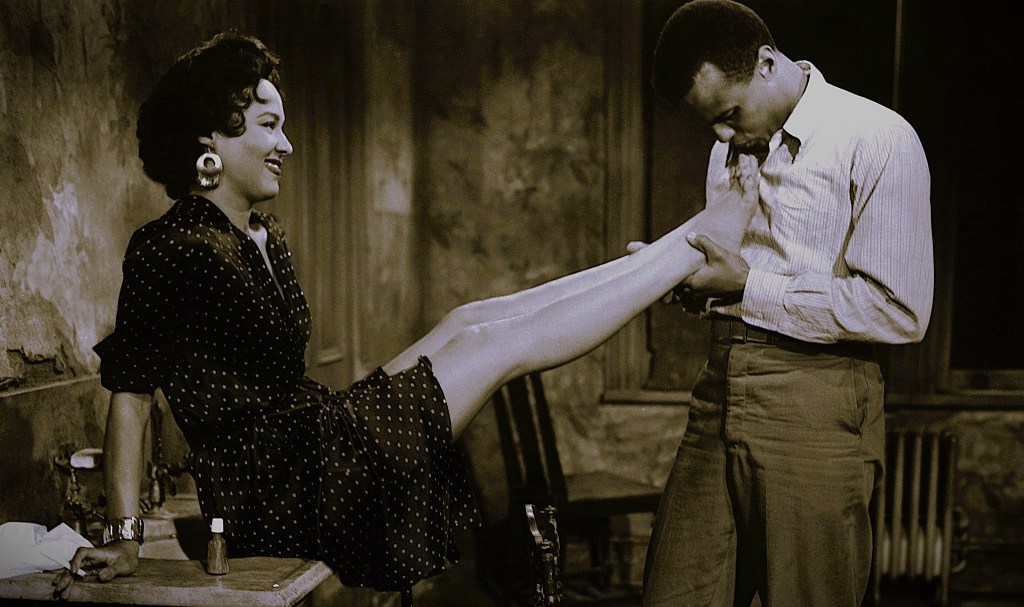
There’s nothing soft or easy about Carmen Jones. The moment Dorothy Dandridge steps into view, hips swaying and sidelong glances, you know you’re not in Fred and Ginger territory anymore. There are no sparkling ballrooms with elegant dancers twirling to airy show tunes. Instead, Otto Preminger’s 1954 film stomps right past the boundaries of the typical Hollywood musical. It sets up shop in a seductive world, where fiery desires collide with suffocating jealousy. Here, the line between love and hate dissolves into smoke.
Many musicals of the era present romance as a sweet diversion. A boy meets a girl. They sing a duet. Maybe a dazzling dance number later leads them into a happy sunset. Carmen Jones, on the other hand, undoes this comforting pattern.
Carmen Jones is based on Georges Bizet’s famous opera Carmen but set in a World War II-era African American life. Instead of Sevilla’s dusty plazas, we have the American South and army barracks. Instead of delicate courtship, we have Carmen, a parachute factory worker who toys with men’s hearts because, well, she can. She lives by her own rules and refuses to bow to anyone’s expectations. She’s been called many things, including “roadside woman.” Still, that label is a complement to one of the most complex, unapologetic female characters in a musical.
Dorothy Dandridge’s performance is electric. She doesn’t just play Carmen; she seems to become her, transforming into a creature of pure instinct and sensuality. Carmen is trouble from the start, she knows it, and so do we. Nonetheless, we keep watching, enchanted, as she wraps men around her dainty fingers.
When Harry Belafonte’s Joe enters the picture, initially, he’s the good soldier. He’s a man with a sense of duty and a nice, respectable fiancée waiting patiently for him. It’s a familiar scenario: the handsome hero, the good girl back home, the temptation of the untamed woman. But here, there’s no neat resolution. Carmen doesn’t exist to be tamed, and Joe can’t resist getting tangled in her destructive orbit.

The tension between Carmen and Joe is charged with a raw sexuality you rarely see in classic musicals. Preminger’s camera lingers on the actors’ sweaty, desperate, faces consumed with longing as they sing. The songs themselves are adapted from Bizet’s original score. Reworked with Oscar Hammerstein II’s English lyrics, they’re infused with jazz and a wonderful flavor of blues. They’re not the bubbly, light songs you’d expect from a 1950s Hollywood musical. Instead, they’re moody and brimming with danger. Even when the characters break into song, it doesn’t feel like a retreat into fantasy. Instead, the music only heightens the intensity, each note emphasizing the inescapable tragedy that’s about to unfold.
Carmen and Joe’s love affair is a slow collision. At first, there’s an intoxicating attraction, Carmen’s teasing grin, Joe’s uncertain gaze, the spark that sets them off into uncharted territory. But as Carmen lures Joe further away from his secure life, you see the cracks forming. His jealousy grows thick and heavy. Meanwhile, her boredom and restlessness chafe like a collar around her neck. Dandridge and Belafonte have an unsettling chemistry that goes beyond simple romance. It goes into dark emotional tug-of-war that can only end in destruction.
Unlike many musicals, Carmen Jones offers no release with a perfectly choreographed ballroom number. There is no moment where everyone ends up smiling. Instead, the dancing here is brash, the singing sultry, and unforgiving.
What makes ‘Carmen Jones’ redefine the musical genre is the way it refuses to soften its edges. The characters are flawed, often unlikable, and they’re trapped by their own hungers. Carmen herself is fearless, but her fearless pursuit of freedom also makes her reckless. Joe’s devotion becomes strangling possessiveness, twisting him from a man of principle into a bitter shadow of himself.
By the time the film reaches its final act, the glitter of the Hollywood musical has been scraped away entirely. We’re left watching something that feels more like a psychological drama. It’s more of a fever dream of lust, control, and ruin than a lighthearted escape. And that’s exactly what sets Carmen Jones apart.
For audiences raised on the neatly packaged love stories with Fred Astaire and Ginger Rogers, Carmen Jones must have been a punch to the gut. First off, it’s an all-Black cast at a time when such a thing was rare in mainstream Hollywood. And they’re not playing servile roles or sanitized caricatures. Instead, they occupy the screen with authority. They’re human beings with desires and dark impulses, pushing against the limitations that society and circumstance have put on them. And in that friction lies a certain honesty and urgency that feel startling, even decades later.
The film doesn’t tidy up its moral messages in a bow. There’s no gentle moral to soothe you as the credits roll. Instead, Carmen Jones leaves you with the unsettling truth that passion can be both exciting and annihilating, that people are not always what they seem, and that love can be as destructive as hate. Carmen Jones doesn’t tiptoe around the ugly parts of human nature. They dive right in with voices raised, saying to the audience, “Take it or leave it.”
In the end, Carmen Jones is a raw, visceral piece of cinema that pushed the boundaries of the genre. It’s a film that dares to ask uncomfortable questions about the nature of love, freedom, and control. And it does it all while making you watch, spellbound, as a “roadside woman” seizes control of her destiny, knowing full well it might be the last thing she ever does.










 Screen Rated