
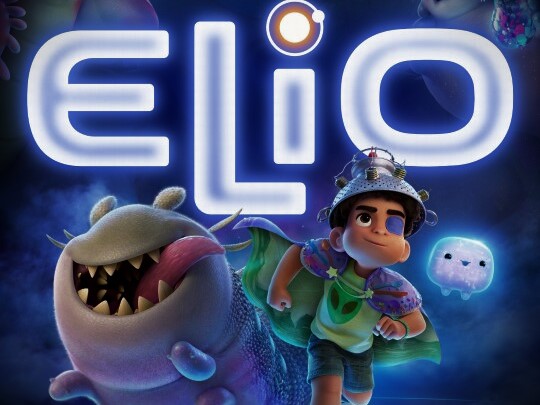
Pixar’s new animated feature, Elio, invites kids to look up at the night sky and wonder whether there is anyone out there who might understand them better than the kids at school do. That spark of curiosity fuels Elio, a 99-minute mix of color and feelings that drops an anxious eleven-year-old into a galactic United Nations called the Communiverse. It is occasionally formulaic, yet still manages to hit enough sweet notes to keep Pixar’s reputation safely in orbit. The film may not be at Toy Story level, but it is nowhere near crashing back to Earth either.
Elio Solís (voiced by newcomer Yonas Kibreab) is obsessed with space and, oddly enough, wants to get abducted by aliens. He’s a kid who would rather tinker with his ham radio and stare at the Voyager probe display than sit with classmates.
He lost his parents recently and now lives with his aunt Olga (Zoe Saldaña). Olga is a major in the Air Force space program, which should give them common ground, yet grief and miscommunication widen the gap between them. Elio finally gets his wish when he gets pulled aboard a starship. A diplomatic mix-up leaves the aliens convinced that this scrawny kid is the official voice of Earth. Rather than correct them, Elio plays along, hoping an honorary seat at the Communiverse will make him feel less alone. Cue bureaucratic blunders, a looming warlord named Lord Grigon (Brad Garrett), and one very adorable space prince called Glordon who might be the best friend Elio never knew he needed. The production shuffled directors during development, ending up with Madeline Sharafian and Domee Shi cutting the final edit, with original creator Adrian Molina still credited as co-director.
Pixar’s character designs sometimes veer into “rubber chew-toy” territory, and the first act on Earth is no exception. Once Elio hits deep space, though, the studio’s art team unloads every crayon in the box. The Communiverse is a rotating kaleidoscope of floating platforms, neon constellations, and alien delegates who look like they wandered in from Star Wars’ cantina after a spa day. A pink manta ray that speaks in bubbles, a plant ambassador who coughs glowing orbs, and an alien avocado species that projects holograms all share the same conference room. The animators clearly had a field day, and that colorful energy smooths over some of the script’s bumps. Younger viewers will soak in the spectacle, while older sci-fi nerds will grin at quick nods to Close Encounters, Flight of the Navigator, and even ALF.
Under the colorful visuals sits a surprisingly tender reflection theme on loneliness. Pixar has explored the topic of kids feeling out of place before, yet Elio tackles the subject from a slightly different angle. The boy is not just misunderstood; he is convinced that all five hundred million habitable planets in the galaxy would be a better home than his actual one. That mindset strikes close to real childhood grief and anxiety, and the movie refuses to dismiss those feelings as a passing phase. A late Carl Sagan quote about cosmic connection arrives right on schedule, but it lands because the story earns it rather than padding a poster.
Kibreab gives Elio a shaking sincerity that never feels overly sweet, and Saldaña finds enthusiasm in Olga’s exhaustion of trying to connect with Elio. The MVP, though, is Remy Edgerly as Glordon, a squishy blue critter with the cut delivery of a WWII pilot. Watching Glordon and Elio bond over shared outsider status provides the film’s biggest laughs and its climax that will put a lump the size of an orange.
The screenplay credits three writers, and you can sense their fingerprints fighting for control. While the theme is solid, there’s little equilibrium in the overall story. The plot goes in and out, especially a clone subplot back on Earth that is funny but loses momentum. Lord Grigon’s arc flirts with real menace before swerving toward sitcom territory, undercutting what the movie just spent ten minutes building. Nonetheless, none of these derail the adventure, yet they keep Elio from joining Pixar originals like Coco or Inside Out.
What I find a little bit redundant is Pixar’s recent habit of turning a hero’s “flaw” into a secret superpower; it’s starting to feel familiar. Elio discovers that the traits that make him odd are also what make him valuable. It is a great message for kids, but the revelation arrives exactly when and how you expect, which lessens its impact. Still, the delivery is enough that parents will forgive the redundancy while discreetly wiping away a tear.
Elio arrives during a rough patch for family films, where many studios chase safe sequels or remakes instead of an original story. Pixar sticks its neck out with an original story about grief, impostor syndrome, and the need to belong. It does not always fire on every thruster, but when it clicks, the movie taps that old Pixar magic wrapped in imaginative world-building. Kids will laugh at Glordon’s gooey tantrums, adults will wince at Olga’s exhausted pep talks, and everyone will walk out humming the score and maybe staring at the sky a little longer than usual.
Elio isn’t quite the Pixar magic we’ve come to expect. But it’s magic enough that it’s worth the price of admission and a jumbo popcorn. Think of it as a solid B-plus trip to the stars, piloted by a studio still willing to risk original stories instead of defaulting to another Toy Story 5. If you have ever felt like the weird kid waiting for a signal that you matter, Elio will send a comforting ping back. And that is a message worth hearing whether you are trapped on Earth or cruising somewhere way beyond infinity and beyond.









 Screen Rated