
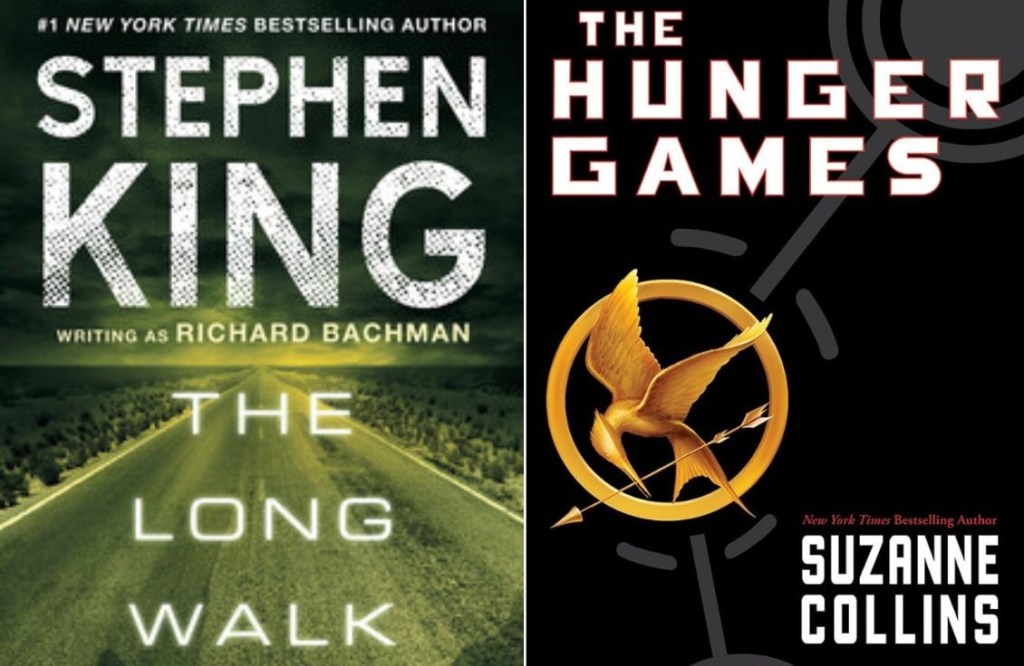
When Suzanne Collins gave us a dystopian world where teenagers are forced to fight to the death for entertainment, many readers thought they were seeing something completely new. But decades earlier, Stephen King, writing under his Richard Bachman pseudonym, had already given us a story cut from the same cloth. His 1979 novel The Long Walk may not have the futuristic style of Panem, but it shares striking similarities with Collins’ work. Both stories push kids into arenas they never asked for. Both ask the question: what happens to innocence when survival is on the line? And both expose society’s appetite for cruelty dressed up as entertainment.
Let’s take a closer look at how these two stories mirror each other, where they differ, and what that says about the evolution of dystopian fiction.
Teenagers as tributes
One of the most obvious similarities between The Long Walk and The Hunger Games is the premise. In King’s novel, forty-nine teenage boys, each representing a U.S. state, volunteer or are coerced into joining a government-sanctioned walk. The rules are to keep walking at a steady pace of four miles per hour. If you stop or fall behind too many times, you’re shot by armed soldiers. The last walker standing wins anything he wants for the rest of his life.
In The Hunger Games, the Capitol demands “tributes” from each district. One boy and one girl between the ages of twelve and eighteen are selected through a lottery system. They are thrown into a televised arena and forced to fight until only one remains. Victory means fame, wealth, and food for their starving family.
In both cases the kids are pawns; the state uses them for spectacle and control. Society watches with a mix of horror and fascination, and the government reinforces its power by reminding citizens that survival is a privilege, not a right.
The horror behind the dystopia
King’s The Long Walk is often classified as horror, while The Hunger Games is shelved under young adult dystopian fiction. But if you peel back the labels, both deal with the horror of systems that pit children against each other. The violence may be more psychological in King’s novel and more cinematic in Collins’ series, but both strike at the heart of how monstrous a society can become.
King doesn’t need mutated beasts or fireballs to make the Long Walk terrifying. The horror comes from endurance, exhaustion, and the gradual stripping away of humanity. As walkers collapse and die, the survivors keep moving, forced to compartmentalize their grief or risk losing focus. The terror lies in how normalized the killings become, how the boys and the spectators accept death as part of the game.
Collins, meanwhile, builds her horror around a grand show. Tributes are dressed up and paraded and celebrated before they’re slaughtered. With environmental hazards, engineered beasts, and traps, The Games are designed for maximum drama to keep the show entertaining. While it reads like action, the underlying horror is how children are being manipulated and destroyed for ratings.
So, is The Hunger Games horror? In a way, yes. Dystopian fiction often shows us exaggerated nightmares of what society could become, and Collins goes heavily into the grotesque nature of entertainment and authoritarianism. It may be written for teens, but its bones are horror.
Human behavior under pressure
What separates King and Collins’ focus? King has always been obsessed with the cracks in human behavior. While it’s obvious that The Long Walk is about the tyranny of government, beyond that, King takes us into a world and has us watch what people will do when stripped down to survival. The boys form alliances, share jokes, and bond in fleeting moments of humanity. Not only do we witness the fragility of friendship, but as the walk continues, paranoia, cruelty, and despair creep in. King uses the contest to explore the desperation of mortality and the selfishness that emerges when only one can survive.
Collins also explores human behavior but leads us into rebellion. Katniss is a survivor; she becomes a symbol. She challenges the system, manipulates public perception, and sparks hope for change. Where King’s characters are crushed by the system, Collins’ heroine fights to dismantle it. The Long Walk is a tragedy contrasted sharply against The Hunger Games revolution.
Entertainment as control
Another eerie similarity between the two works is how the games serve as entertainment for the masses. In King’s novel, spectators line the roads to cheer and gawk as boys collapse and die. They bring picnics, wave flags, and treat the deaths like a sporting event. The cruelty isn’t hidden; it’s celebrated. It’s reminiscent of the early days of the American Civil War, when people would picnic and watch as men killed each other.
Collins takes this idea and blows it up into a national broadcast. The Hunger Games are televised, turned into a glamorous spectacle that districts are forced to watch. Tributes become celebrities before their deaths, and the Capitol indulges in fashion, betting, and gossip. Both King and Collins expose society’s appetite for bloodsport, but Collins makes the metaphor sharper by connecting it to reality television and consumer culture.
A matter of tone
Tone may be the biggest divider between The Long Walk and The Hunger Games. King’s novel is bleak, suffocating, and deliberately slow. The walk itself is monotonous, and that monotony breeds horror. By the end, readers feel the same exhaustion as the characters. There is no triumphant ending, only emptiness.
The Hunger Games, while dark, offers moments of hope, love, and defiance. It is a story designed to empower as much as to terrify. Katniss’ compassion for Rue, her clever defiance with Peeta, and her eventual rebellion give readers a sense of resistance against the cruelty. Collins writes for a young adult audience, and while she doesn’t shy away from violence, she tempers it with resilience.
King offers no such comfort. His story suggests that endurance leads only to death and that the system will always win.
Influence or coincidence?
It’s worth asking if Collins drew inspiration from King. She has cited reality TV and the Iraq War as her main influences, but it’s hard not to see elements of The Long Walk in her work. kids as tributes, one survivor, state-sanctioned cruelty, the setup is too similar. Either way, whether it’s direct influence or just a shared cultural nightmare, The Hunger Games feels like a younger sibling to King’s novel.
What’s interesting, though, is how each found its audience. The Long Walk has remained a cult classic, admired by horror fans and readers of King’s darker works. The Hunger Games became a global phenomenon, selling millions and creating blockbuster films. Perhaps the difference lies in tone. King demands you confront despair, while Collins offers a path toward hope.
Why we keep returning to this trope
So why do we keep returning to the idea of kids as tributes in dystopian settings? Maybe because it’s the purest way to dramatize innocence colliding with corruption. Children symbolize potential and future. When society forces them into violence, it highlights just how far things have fallen. Whether it’s King showing the rot of authoritarian control or Collins showing the cruelty of an empire, the effect is always the same. We’re forced to ask what kind of world would sacrifice its youth to maintain power.
The answer, disturbingly, is not as far-fetched as we’d like to think. From gladiator arenas to child soldiers in real wars, the idea of using youth as pawns has always haunted human history. These stories just sharpen the metaphor.
Two stories, one nightmare
At first glance, The Long Walk and The Hunger Games may look like different beasts, where one is a psychological horror novel and the other a YA dystopian saga. Nonetheless, beneath the surface, they share the same DNA. Both trap teenagers in cruel contests where survival means sacrificing their humanity. Both force readers to confront the ways entertainment and power feed off suffering. And both remind us that the true horror isn’t the games themselves; it’s the societies that create them.
King’s story ends with despair, Collins’ with rebellion. One crushes hope, the other ignites it. Together, they form a powerful mirror of how dystopian fiction has evolved from bleak warnings about human behavior to stories that dare to imagine resistance. And maybe that’s why both will always have an audience. They remind us of the cost of survival, the fragility of innocence, and the dangers of letting spectacle blind us to cruelty.




 Screen Rated