Directed by Maggie Gyllenhaal | 2026 | Rated R
There is something genuinely exciting about watching a filmmaker throw caution to the wind. Maggie Gyllenhaal, whose directorial debut “The Lost Daughter” announced her as a formidable voice behind the camera, returns with a film that could not be more different in temperament or scale. The Bride is loud, visually audacious, and stuffed with ambition, and while it stumbles under the weight of its own ideas, it rarely stops being interesting.
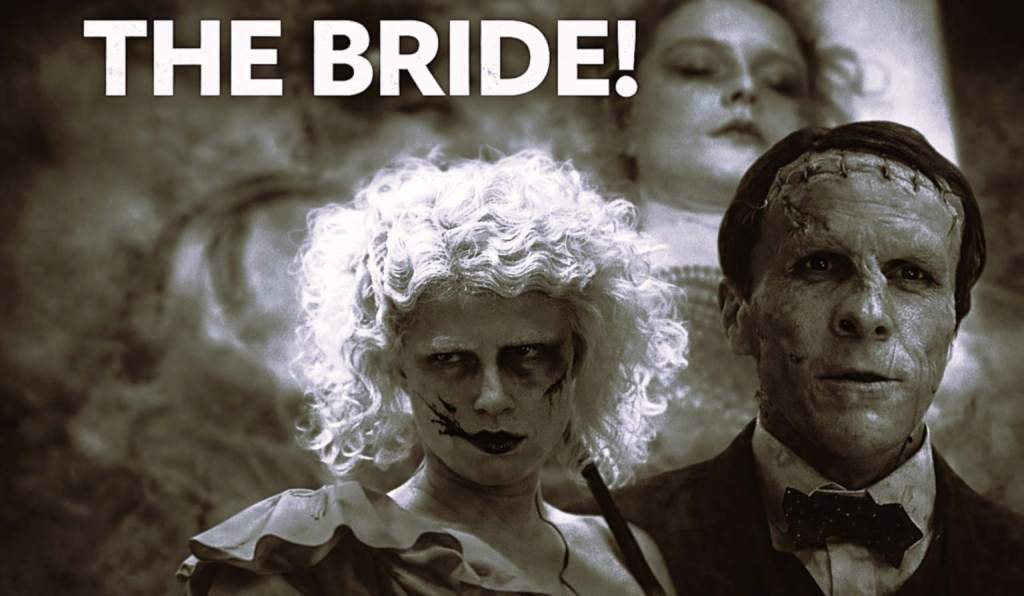
The story borrows from the mythology of 1935’s classic monster cinema, repositioning the story entirely around its female subject. Jessie Buckley plays Ida, a sharp-tongued woman in 1930s Chicago whose violent death at the hands of gangland enforcers is only the beginning of her story. After being exhumed and reanimated by the brilliant, wryly pragmatic Dr. Euphronious (Annette Bening), she wakes up without her memories and finds herself bound, by the creature known as Frank (Christian Bale), to a life she never chose. What follows is part fugitive road picture, part gothic romance, and part feminist provocation, with the film genre-hopping so freely it sometimes feels like it forgets where it started.
Buckley gives everything she has to this role. Whether or not the material always meets her at her level is another question, but watching her physicalize and vocalize a woman discovering herself in real time is a genuine pleasure. The character’s slow reclamation of identity, peppered with literary allusions and raw fury, lands with real force in the film’s better moments. Bale, for his part, brings a surprising gentleness to Frank; he is lumbering and awkward and oddly touching, a creature whose loneliness is palpable even as his manipulations complicate any straightforward sympathy.
Visually, the film is a triumph. Cinematographer Lawrence Sher and production designer Karen Murphy conjure a world that sits somewhere between a fever dream and a pulp paperback cover, shot through with the smoky glamour of 1930s noir while winking constantly at its own artificiality. Costume designer Sandy Powell outdoes herself with creations that feel both historically grounded and wildly theatrical. The Bride’s signature ensemble, all burnt orange silk and sculptural puffed sleeves, instantly stakes a claim as one of the more memorable screen outfits in recent memory.
Where the film earns its asterisks is in the writing. Gyllenhaal has a lot on her mind, and she is not shy about sharing all of it at once. The Bride rarely stops speaking, and while the intent is clearly to position her uncontainable voice as a form of resistance, the cumulative effect tips from invigorating into exhausting. Scenes that might benefit from silence or ambiguity are instead filled with dialogue that announces its own themes at considerable volume. The film trusts its audience less than it should.
The supporting cast is largely excellent even when underused. Bening brings dry authority to every scene she occupies. Penelope Cruz, playing detective Myrna Malloy, brings warmth and wit to a role that deserved more screen time. Jake Gyllenhaal appears as a golden-age Hollywood matinee idol whose magnetism Frank worships from afar, and the casting carries its own sly meta-commentary on stardom and projection.
There is a version of The Bride that tightens its sprawling instincts into something more devastating. As it stands, the film is a fascinating near-miss, one that contains flashes of genuine brilliance alongside stretches that feel overstuffed and undercooked. The final act in particular resolves things in a manner that is tidier and more conventional than the chaos that precedes it might have promised.
And yet: this is exactly the kind of film the industry rarely allows to exist, especially from a woman director working at this scale. Gyllenhaal takes real creative risks here, and even when they do not entirely pay off, the act of swinging this freely deserves acknowledgment. The Bride is flawed, uneven, and occasionally its own worst enemy, but it is never timid, never boring, and never less than fully committed to its own strange vision. That counts for something.
the bottom line is it’s a visually spectacular, thematically overstuffed monster movie reinvention that earns respect for its ambition even as its screenplay occasionally buries its own best instincts. Buckley and Bale make it worth watching.



 Screen Rated
Leave a comment