
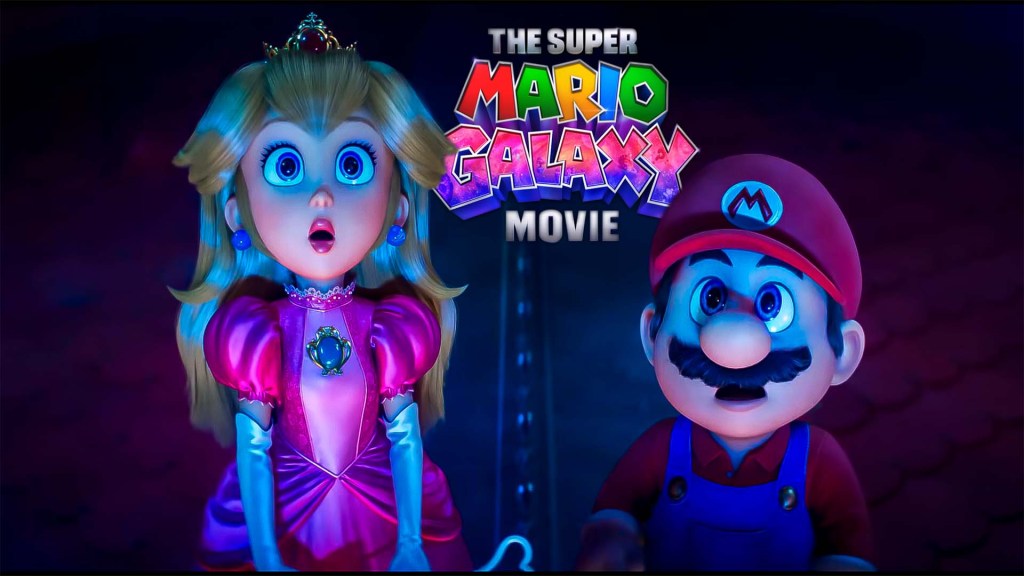
People will say this movie is not trying to win awards, and it’s a kids’ movie. Well, I’m one of them. A cynic, on the other hand, might say that a movie can be all of those things and also include a degree of depth, reflectiveness, craftsmanship, and trust in its audience. Yes. It IS for kids. And I’m pretty sure that while it can be all those things, kids aren’t worrying much about depth, thoughtfulness, and reflectiveness in movies. They’re there for giggles and laughs.
Yes, it’s that simple. This is a kids’ movie. Not a movie that happens to feature animated characters. Not a family film carefully engineered to smuggle in sophisticated adult subtext. A kids’ movie, full stop, no asterisks. If you walked into the theater with a fully developed prefrontal cortex and left feeling like the film didn’t give you enough room to breathe, congratulations: you used the wrong brain.
And that’s really the crux of it. Critics have lined up to complain that The Super Mario Galaxy Movie rushes breathlessly from one set piece to the next, barely pausing to let its story breathe. Rosalina gets kidnapped, Bowser Jr. schemes, Yoshi shows up with almost zero introduction, Fox McCloud materializes out of nowhere like a charismatic mercenary from a different franchise entirely, and before you’ve processed any of it, the credits are rolling. For an adult mind, trained to expect narrative architecture and character arcs with room to resonate, that chaos can feel genuinely disorienting. But here’s the thing those reviews are leaving out: this is a kids’ movie, and the eight-year-old sitting two rows in front of you didn’t need to breathe. She needed the next cool thing to happen right now.
Kids don’t sit in the theater demanding that their emotions be allowed to settle. They sit there demanding more Lumas, more Yoshis, and more Fox McCloud doing something awesome. The relentless, gear-grinding pace that reads as exhausting to a 35-year-old dad is essentially cocaine for a child, and the film knows it. Directors Aaron Horvath and Michael Jelenic, working again from Matthew Fogel’s script, clearly understand who they’re making this for, even if some of their critics seem to have forgotten. This is a kids’ movie. It moves like one, it thinks like one, and kids, bless them, will follow it every step of the way.
That’s not to say the film is without its problems. The plotting is arguably The Super Mario Galaxy Movie‘s biggest weakness, and even by kids’ movie standards, it’s thin. Rosalina makes a strong first impression, arriving with the kind of kinetic, over-the-top energy you’d expect from a Saturday morning cartoon, only for the film to almost immediately bench her and barely look back. Yoshi (voiced charmingly by Donald Glover) shows up mid-story with the narrative equivalent of a shrug, dropped into the group as if he’d always been there. Toad gets shortchanged. Mario’s and Peach’s mutual crush goes, essentially, nowhere. These are real criticisms, and a slightly more patient screenplay could have been done better by them.
But, and it’s a big but, this is a kids’ movie, and kids do not rank “underutilized supporting characters” among their primary concerns. They’re there for the bright colors, the familiar music cues woven into Brian Tyler’s score, the delightful sequence where a miniaturizing weapon reduces Mario and Luigi to bumbling, oversized-headed minis, and the glorious absurdity of Bowser Jr., brought to life by Benny Safdie as a wound-up little villain desperately trying to win his father’s approval. That stuff lands. It lands every time.
Visually, the film is gorgeous: dazzling and intricately rendered, bursting with Easter eggs that will send young Nintendo fans into rapturous pointing fits. And while some may lament the absence of another showstopping musical moment (don’t go in expecting Jack Black to serenade you again), Glen Powell’s Fox McCloud turns out to be a genuine scene-stealer, the kind of addition that makes you wish the whole movie had his energy.
Could The Super Mario Galaxy Movie be better? Absolutely. Its predecessor was built around something emotionally coherent, a throughline this sequel never quite finds. But “could be better” and “fails its audience” are two very different things, and this film’s audience, let’s remember, is kids. Kids who will follow this film’s frenetic logic with total ease, who will rewatch it on loop for the next eighteen months, and who will not once wish the pacing had given them more time to reflect.
Super Mario galaxys’ biggest strength is knowing its audience…this is a kids’ movie, full stop, no asterisks



 Screen Rated
Leave a comment