
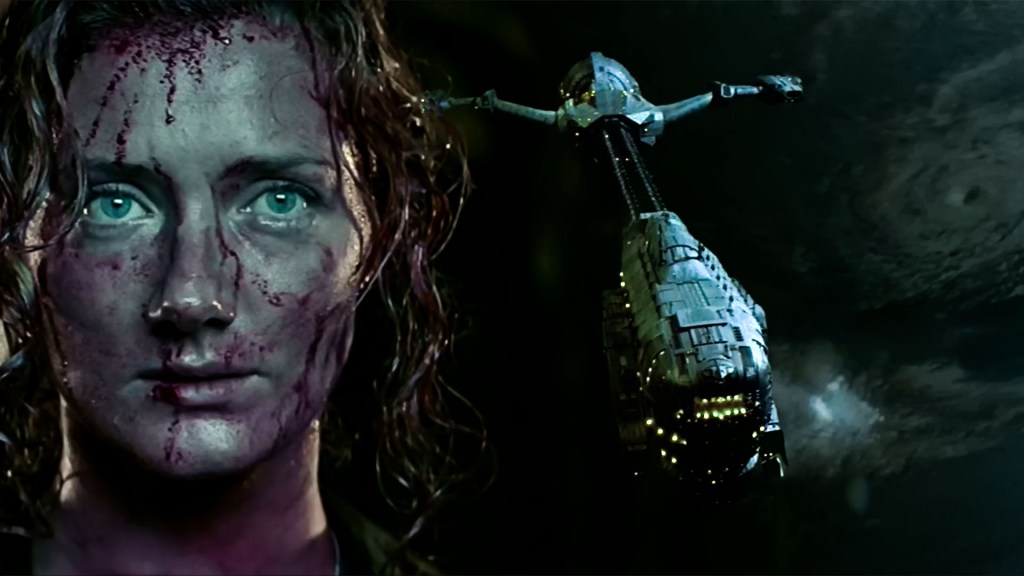
Some movies miss their moment. They came out in the wrong decade, got judged by the wrong standards, and ended up becoming cult classics only after the world finally caught up. In the nineties, Hollywood was mostly making teen slashers, upbeat blockbusters, and sleek space adventures. But, in 1997, a movie came out that went against that norm. With a mix of cosmic horror, Gothic sci-fi, and nightmarish imagery, no one was ready for Event Horizon. Timing is everything, and this movie showed up at the worst possible time.
Looking back, it’s easy to see why it struggled. The late nineties were filled with shiny sci-fi. You had movies like Men in Black, Starship Troopers, Contact, and the always optimistic Star Trek. Sci-fi was fun again. It was hopeful. It was clean. Then along came Event Horizon, looking like a metal album cover with a NASA budget. The corridors were grungy and claustrophobic. The lighting was drenched in reds and shadows. The tone was bleak, heavy, and supernatural. It stood out, but not in the way studios wanted.

Critics did not know what to do with it either. Some labeled it too violent. Some called it incoherent. Others thought it leaned too far into horror to count as sci-fi. And the irony is that the things critics disliked are the same things fans today like. The brutality, the cosmic madness, the strange dream logic, the flashes of hell. Moreover, everything that confused people about Event Horizon in 1997 became the foundation of modern sci-fi horror.
Today’s viewers are ready for this kind of weirdness. They want risks. They want movies that swing big even if they miss. Modern audiences embraced films like Hereditary, Annihilation, Underwater, Mandy, and Alien: Romulus. These movies treat cosmic terror and psychological collapse as a normal part of the genre. That is exactly the territory Event Horizon tried to explore long before it was acceptable. If this film were released today, horror fans would be lining up with theories and breakdown videos the same night.

Another factor that hurt the movie was studio interference. The original cut was much darker and much longer. Paramount feared the dreaded NC-17 rating and forced the director to remove entire scenes. Thirty minutes vanished. Key character moments were trimmed. Plot threads were cut short. The theatrical version feels like it is missing a few pages. Today people treat the missing footage like buried treasure. The myth of the lost cut is one of the biggest reasons the movie still gets talked about. Modern audiences love a mystery, especially when the studio is the villain of the story.
There is also the simple fact that horror has changed. In the nineties, mainstream horror was stuck between slashers like I Know What You Did Last Summer, Scream, and Urban Legend and creature movies like The Faculty, Mimic, and Species. Cosmic horror was something new. The idea of a sentient ship dragging people toward madness was too strange. Now it fits right in with the way viewers interpret trauma, mental collapse, and supernatural forces. A movie like Event Horizon does not have to choose between sci-fi and psychological horror anymore. The genre has expanded. Audiences have expanded with it.

Streaming would have boosted the film’s survival too. Back then, if a movie didn’t do well in theaters, it disappeared. Today a divisive film can trend on social media, get rediscovered on streaming, and generate a dedicated fandom overnight. Imagine the online buzz if people could pause and replay those quick flashes of chaos. Imagine the YouTube videos about the gravity drive being a gateway to a dimension of pure pain. Imagine the fan theories about the ship being alive. This movie was built for the social media age; it just happened to come out before social media cared about movies in that way.
The most interesting thing about Event Horizon is that its legacy did not need box office success. Its influence is everywhere. You can see it in Dead Space, Pandorum, Sunshine, and countless games that embraced industrial Gothic design. The idea of hell in space became a staple. Creators who watched the movie when they were younger borrowed its tone, its imagery, and its sense of overwhelming dread.
If Event Horizon were released today, it would be a cultural event. Horror fans would pick apart every frame. Sci-fi fans would debate the physics and interdimensional theory. The marketing would play up the “lost cut” legend. The studio would let the movie go fully unhinged instead of trimming it down. What was once considered too much would now be celebrated for its boldness.
Sometimes a film is not made for the year it debuts. Sometimes it is made for the generation that discovers it later. Event Horizon belongs to that second group. It failed in 1997 because the world was not ready. It will dominate today because the world finally is.




 Screen Rated