
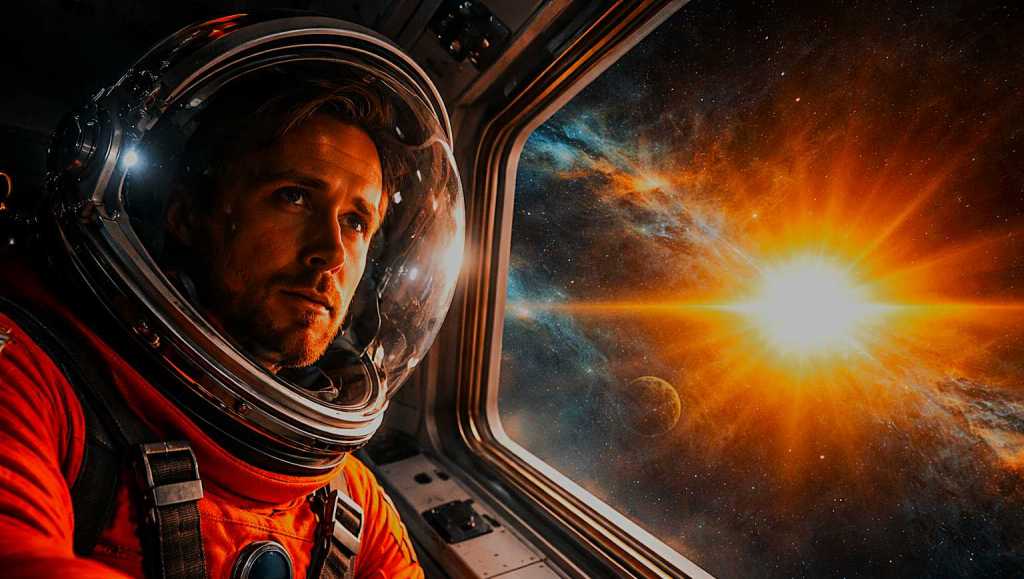
Directed by Phil Lord and Christopher Miller | Starring Ryan Gosling, Sandra Hüller, James Ortiz
What a relief it is to sit inside a massive blockbuster and feel your brain light up alongside your heart. Phil Lord and Christopher Miller’s Project Hail Mary is exactly that kind of film: a sci-fi adventure that trusts its audience to follow along with genuine scientific curiosity, then rewards that trust with a friendship so unexpectedly warm it borders on miraculous.
The film opens with Dr. Ryland Grace, played by Ryan Gosling, waking up alone aboard a spacecraft he cannot immediately identify, with a name he cannot immediately recall. His two crewmates are dead. The sun back home is slowly dying. And he has no idea how any of it came to be. It is a bold, disorienting opening gambit that pays off beautifully as the film toggles between Grace growing awareness of his circumstances and the earthbound flashbacks that explain how one rumpled middle-school science teacher ended up as humanity’s best remaining hope.
Gosling brings tremendous warmth and comic timing to the role, and his performance is anchored in something refreshingly earnest: this is a man who genuinely loves science. Watching Grace talk himself through problems, narrate his own experiments with barely suppressed glee, and react to each new discovery with the unguarded enthusiasm of someone who never stopped finding the universe fascinating is one of the great pleasures the film has to offer. In a landscape crowded with reluctant, brooding heroes, Grace is a revelation precisely because he is so willingly, almost cheerfully, engaged.
The film takes a genuinely inspired turn when Grace discovers that an alien spacecraft has parked itself nearby, on a mission strikingly parallel to his own. The creature aboard, whom Grace eventually names Rocky, is one of the most inventive and emotionally satisfying alien creations in recent cinema history. Rocky is all spidery stone and warbling frequencies, with no face and no shared language, and yet the bond that develops between him and Grace unfolds with a tenderness and humor that the film earns completely. The communication breakthrough between them, built from first principles through mathematics and music, is presented with such playful ingenuity that it generates genuine suspense and delight in equal measure.
Lord and Miller bring their signature wit and kinetic energy to the production without ever letting the comedy undercut the stakes. The humor here is character-driven and earned. It grows naturally from the absurdity of two beings from completely different corners of the universe sitting across from each other, figuring out shared chemistry experiments, and gradually discovering that curiosity is a universal language. James Ortiz, who voices Rocky and served as lead puppeteer, deserves enormous credit for making that alien presence feel alive and specific.
Sandra Hüller appears in the flashback sequences as Eva Stratt, the formidable government official steering the world’s last-ditch survival effort, and she is magnificent. Hüller plays Stratt with a careful economy of expression that makes every rare moment of vulnerability land with surprising force. There is one scene involving an impromptu karaoke performance that should not work at all, and yet it becomes one of the most unexpectedly moving moments in the entire film.
Cinematographer Greig Fraser, whose work on Dune: Part Two already demonstrated a rare ability to make alien environments feel simultaneously majestic and believable, does extraordinary work here. The visual language of the film shifts depending on whether we are inside the cramped, functional logic of Grace ship or floating through the luminous mysteries of deep space, and those tonal shifts feel organic rather than showy.
What makes Project Hail Mary genuinely special is its conviction that intelligence and collaboration are not just useful tools but heroic qualities in their own right. The film celebrates the act of thinking, of listening, of staying curious in the face of catastrophe. Its climactic emotional beats do not hinge on brute force or last-minute violence but on two very different beings choosing to trust each other when the math says they probably should not.
At over two and a half hours, the film moves with a confidence that makes its runtime feel shorter than it is. Drew Goddard’s screenplay handles an enormous amount of scientific exposition without ever turning dry or didactic, weaving the necessary technical detail into character moments so seamlessly that you absorb the concepts almost without noticing. The pacing has a pulse, and Lord and Miller maintain it even through the quieter, more contemplative stretches.
Project Hail Mary is the rare big-studio film that feels both broadly entertaining and quietly radical. It imagines a future in which humanity’s survival depends not on weapons or willpower but on a middle school teacher’s willingness to keep asking questions.








 Screen Rated
Leave a comment