‘The Boy and the Heron’ is another Miyazaki Masterpiece
When a legendary artist like Hayao Miyazaki releases a new film, it’s an event in and of itself. The Boy and the Heron, Miyazaki’s latest movie, exceeds expectations, blending fantasy and reality in a way that only this master storyteller can. This 2023 Japanese animated fantasy film, produced by Studio Ghibli, is one more nod to Miyazaki’s storytelling and ability to simultaneously create a world rooted in the real world and unbound by reality.

Plot Overview
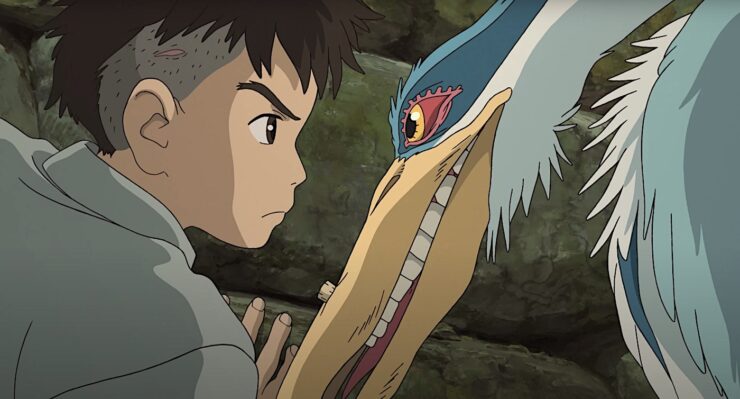
Set during the turbulent times of World War II, The Boy and the Heron follows the journey of 12-year-old Mahito Maki. After losing his mother in a hospital fire, Mahito moves to the countryside with his father, Shoichi, and his new pregnant stepmother, Natsuko. Grief-stricken and angry, Mahito is drawn into a mystical adventure by a talking gray heron. This mysterious bird promises to reunite Mahito with his late mother, leading him into a fantastical world filled with magical creatures and existential revelations.
An unexpected journey
As with many Ghibli films, the story structure is a dream-like journey where the boundary between reality and fantasy blurs. The first part of the movie, which deals with Mahito’s life post-tragedy, is rooted in emotional realism. Miyazaki neatly portrays a young boy’s struggle with grief, illustrated by Mahito’s self-harm and his longing for his mother. This sets the stage for the fantastical adventure that follows.
When Mahito steps into the otherworldly realm, the film takes on a vibrant, surreal quality. He encounters a host of bizarre and intriguing characters, including anthropomorphic parakeets, a pyrokinetic girl named Himi, and the Birdman—a flightless creature that was once a heron. Each character and encounter pushes Mahito closer to understanding his own pain and the difficulties of the world around him.
Themes
The Boy and the Heron is emotionally heavy, with themes of loss, self-discovery, and the clash between fantasy and reality. Miyazaki, drawing heavily from his own childhood experiences, creates a story that is meaningful to both children and adults. The story is a reflection on growing up and finding one’s place in a world that is often harsh and unforgiving.
Miyazaki’s father’s involvement in building fighter planes during the war and his family’s evacuation to the countryside mirror Mahito’s own life in the film. This autobiographical touch makes it not just a fantastical tale but a personal journey for Miyazaki himself.
The visuals and music
As expected from a Studio Ghibli production, the animation in The Boy and the Heron is amazing. Miyazaki’s imaginative landscapes and character designs are brought to life with meticulous detail and his usual vibrant colors. The fantasy sequences, in particular, are visually stunning, filled with awe-inspiring imagery that will have the viewer hypnotized from beginning to end.
The score, composed by Joe Hisaishi, is a perfect accompaniment to the film’s emotional and visual landscape. Hisaishi’s music enhances the storytelling, capturing the essence of each scene. The theme song, “Spinning Globe,” written and performed by Kenshi Yonezu, captures the film’s central themes of transformation and continuity.
A film for all ages
The Boy and the Heron, while steeped in fantastical elements, speaks to universal experiences of loss and strength. Mahito’s journey is one that many can relate to, as it encapsulates the transition from childhood innocence to the sometimes hardened realities of adulthood. Miyazaki’s ability to convey complex emotions through his characters makes the film deeply moving.
However, as with any strong emotions and dealing with grief, the film’s thematic structure may be challenging for younger viewers. Likewise, the shift from a realistic setting to a highly surreal one can be disorienting. Yet, this is where Miyazaki’s shines—like Spirted Away, he relies not just on plot but on the emotional significance of his story. Even if the fantastical elements seem confusing at times, the underlying emotions are clear and impactful.
The Boy and the Heron has been met with critical acclaim, praised for its storytelling, animation, and emotional reverence for loss and grief. Its intentional lack of pre-release promotion, with Studio Ghibli choosing not to release trailers or detailed information, created an air of mystery and anticipation. This strategy paid off, as the film became the fifth highest-grossing Japanese film of all time, earning $294.2 million worldwide.
Among its numerous awards, the film won the BAFTA Award for Best Animated Film, the Golden Globe Award for Best Animated Feature Film, and the Academy Award for Best Animated Feature. These honors reflect not just the film’s artistic excellence but also its universal appeal and emotional significance.
The Boy and the Heron is another example of Hayao Miyazaki’s legacy as one of animation’s greatest storytellers. It’s a film that combines the magical with the real, the personal with the universal. Through Mahito’s journey, Miyazaki explores reflective themes of loss, resilience, and the acceptance of life’s difficulties.
The Boy and the Heron is about how we live, cope, and find meaning in a world that is constantly changing. In an era where animated films often prioritize spectacle over substance, The Boy and the Heron stands out as a work of art that speaks to the soul. It’s a powerful piece of storytelling. For fans of Studio Ghibli and newcomers alike, this film is a must-watch, offering a beautiful journey that will linger long after the credits roll.